
Port & logistics
ISO tank cleaning operations that need a defined flow for drainage, cleaning, drying and inspection.
Tank container cleaning
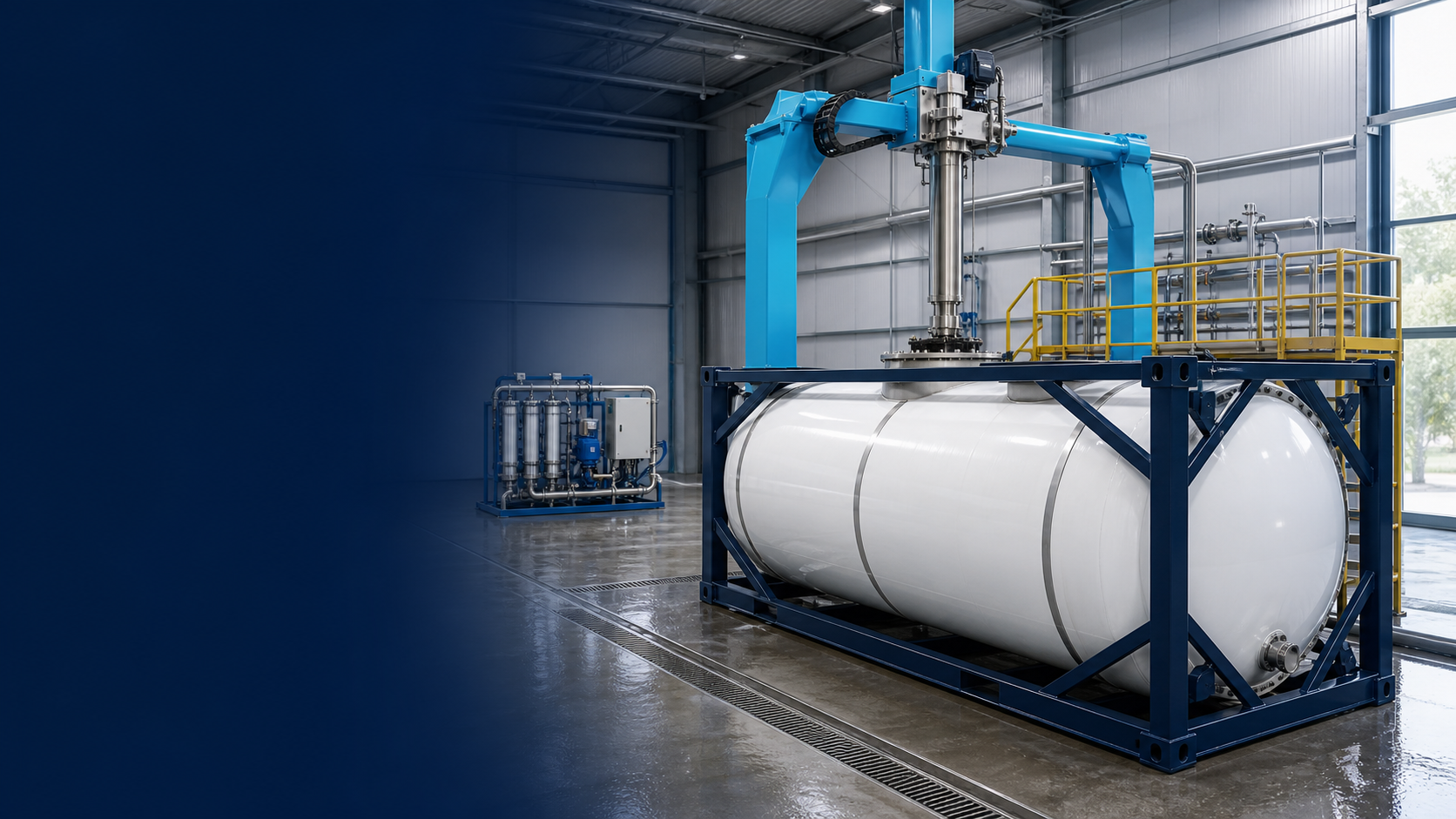
A project-configured cleaning system for ISO tank containers, combining vessel access, high-pressure interior cleaning, drying, controls and recovery interfaces in one operating scope.
Application scope
The supplied product material describes automated cleaning for standard 20-foot ISO tanks used with chemical, food and oil cargoes. Each project is assessed around the actual tank, previous cargo, cleaning target and site interfaces.
ISO tank cleaning operations that need a defined flow for drainage, cleaning, drying and inspection.
Projects evaluated around residue management, utility availability, effluent handling and operating safeguards.
Cleaning processes configured around the customer’s hygiene procedure, cargo requirements and validation method.
Site layouts that may require parallel cleaning positions and coordinated utility, treatment and control interfaces.
Typical process sequence
This is an English adaptation of the supplied product-process material. The final sequence, timings, temperature, pressure and inspection method are confirmed per cargo, tank and local operating procedure.
Prepare the tank and direct residual liquid to the designated collection path.
Apply the selected steam-conditioning step after the site’s venting and safety procedure.
Align the cleaning assembly to the tank access point and establish the operating position.
Use a rotating cleaning head and selected cleaning medium to cover the tank interior.
Connect the wastewater and exhaust paths, then apply the selected heated-air drying step.
Complete the customer-defined visual, sensor-based or manual inspection procedure.
System modules
Modules are selected according to the intended process rather than sold as a fixed one-size-fits-all package.
Automated cleaning integration, positioning or travel arrangement, rotary 3D cleaning head, sealing cover and image-feedback options.
Cold-water or hot-water process equipment, filtration, high-pressure supply and the selected pressure-control arrangement.
Steam-conditioning interface, steam-heated drying, detergent storage, metering and level-control modules where specified.
PLC-based operating controls, touch-screen interface, operator station and process feedback selected for the project.
Collection, pumping, treatment and exhaust-handling interfaces defined with the site’s environmental process scope.
Platform, lifting support, pipework, valves, instruments and site-specific installation materials as required.
Engineering reference
The following values are reference points from the supplied Chinese project material, not a universal specification or commercial offer.
Reference application for standard ISO tank containers.
To be selected for the cleaning medium and process.
Reference flow: 60–65 L/min.
Reference air volume: 20,000 m³/h.
Reference temperature range from the supplied project data.
Cycle duration depends on residue, tank configuration and the selected process.
Project discussion
JAGUI will use the operating context to structure the initial equipment conversation.